Used Car Buying Guide: How to Get a Reliable Car Without Overpaying
A 2-3 year old car costs 30-40% less than new. Here's how to find, inspect, negotiate, and finance a used car the smart way.
Shelly Vargas
Behavioral Economics & Consumer Credit
A new car loses somewhere around 20% of its value in the first year and roughly 40–50% by year five. That depreciation is real money leaving your pocket — you just don't feel it until trade-in time. A well-chosen 2-to-3-year-old car with 25,000–40,000 miles gets you nearly all the reliability and most of the features for 25–40% less than new, and lets the first owner eat the steepest part of the depreciation curve.
The catch is that buying used shifts the risk onto you. Nobody is standing behind the car unless you verify its condition yourself. Here's how to do that, in order.
Set the budget on total cost, not the monthly payment
Dealers sell monthly payments because payments hide the real price. A $420 payment sounds the same whether it's 48 months at a fair rate or 84 months at a bad one — but the second version costs you thousands more and leaves you owing more than the car is worth for years.
Work out what you can pay in total, then remember the sticker isn't the whole bill:
- Sales tax, title, and registration: varies by state, but commonly adds 5–10% to the purchase price.
- Insurance: get an actual quote on the specific model before you buy. Some cars cost $40–$80 a month more to insure than similar alternatives.
- Immediate maintenance: budget $500–$1,000 for tires, brakes, or fluids the seller deferred. Used cars almost always need something.
Get pre-approved before you ever visit a dealership
Walk in with financing already arranged from your bank or a credit union, and the dealer's finance office has to beat your rate instead of setting it. Credit unions are consistently the cheapest source of used-car loans, often 1–2 percentage points below dealer financing. On a $18,000 loan over five years, two points is roughly $1,000.
Pre-approval also converts you into a cash buyer for negotiation purposes: you can talk about the price of the car, not the payment. If the dealer later beats your rate with no strings, great — take it. But make them earn it.
Pick boring, reliable models on purpose
The used market pays you to be unexciting. Toyota Corolla and Camry, Honda Civic and CR-V, Mazda3 — these hold up in reliability rankings from Consumer Reports year after year, parts are cheap, and any mechanic can work on them. A used luxury German sedan costs the same up front and can quietly bill you $2,000+ a year in repairs once the warranty is gone.
Check the specific model year, not just the model. A generally great car can have one bad year (a new transmission design, a problem engine). Search "[model] [year] problems" and check complaint volume at NHTSA.gov before falling in love.
Verify the car's history — then verify the car
- Run the VIN through a Carfax or AutoCheck report. You're looking for accidents, title brands (salvage, rebuilt, flood), odometer inconsistencies, and how many owners it's had. Many dealer listings include a free report; for private sales, $30–$45 is money well spent.
- Check for open recalls at NHTSA.gov/recalls using the VIN. Recall repairs are free at any franchised dealer for that brand, but you want to know what's outstanding.
- Be paranoid about flood cars, especially after hurricane seasons. Musty smell, silt under the seats or in the spare-tire well, fog inside light housings, corroded connectors under the dash. Flood damage can total a car electrically months after it looks fine.
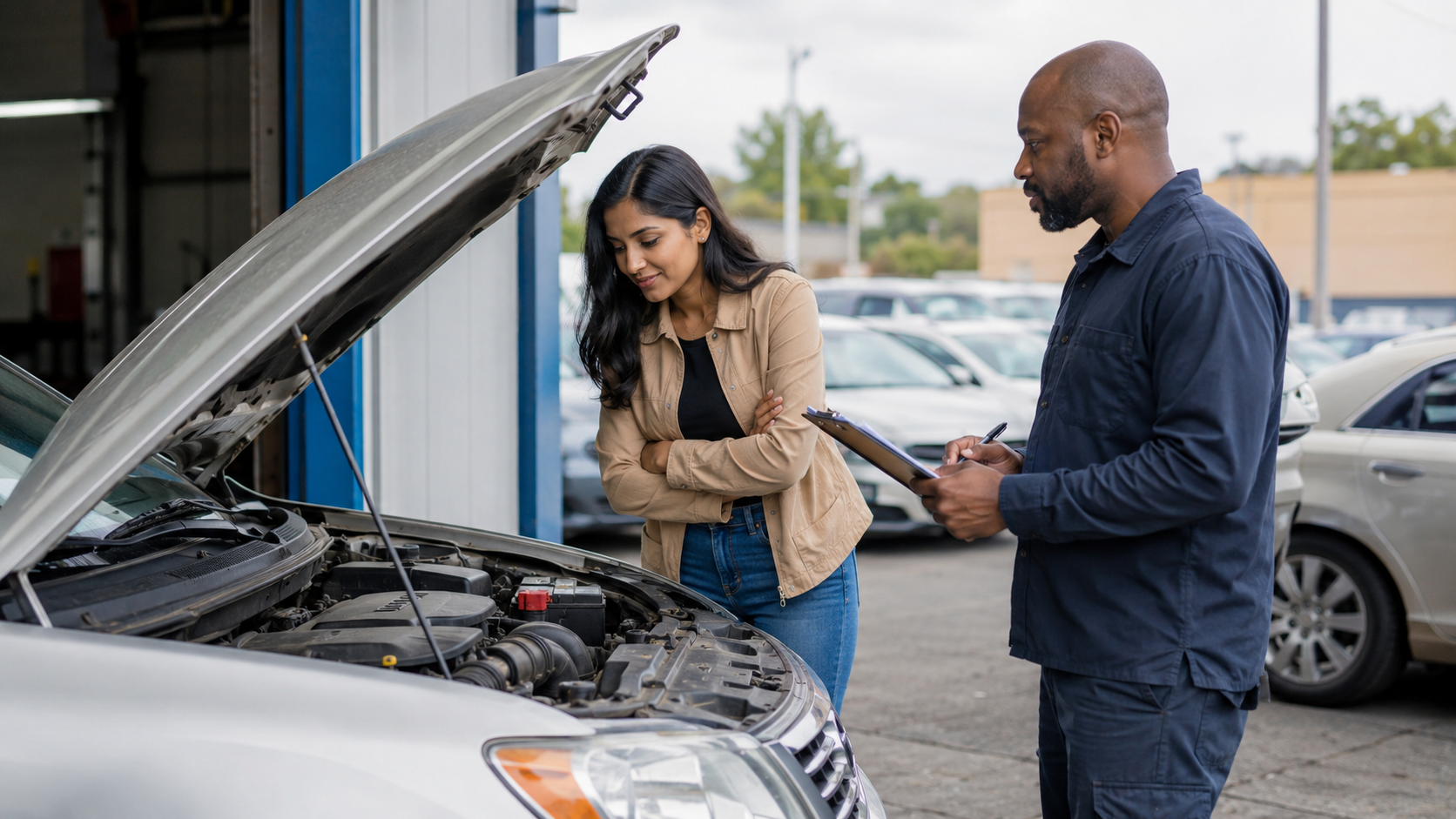
- Pay a mechanic $100–$200 for a pre-purchase inspection. This is the single non-negotiable step. An independent mechanic on a lift will find the leaking gasket, tired suspension, or bodywork over crash damage that a test drive never reveals. Any seller who refuses an inspection has told you everything you need to know. Walk.
On the test drive, take at least 20 minutes and cover highway speed, stop-and-go, and tight parking. Radio off. Listen for clunks over bumps, whining at speed, and hesitation when accelerating. Test every button, window, and vent — a dead AC compressor is a $1,000–$2,500 repair.
Negotiate the out-the-door price
- Know the fair market value before you talk numbers. KBB.com and Edmunds give price ranges for the exact year, mileage, trim, and zip code. Anchor to that, not to the asking price.
- Negotiate one number: the out-the-door price, including all fees. Dealers pad deals with doc fees, "reconditioning," and add-ons like VIN etching and nitrogen-filled tires. Most of that is profit, not product.
- Use the inspection findings. Worn tires are a $400–$800 line item; brakes, $300–$600. "The inspection found it needs tires and rear brakes, so I'm at $14,200" is a normal, reasonable sentence.
- Be genuinely willing to leave. The best price movement happens after you stand up. If the deal is bad, there is always another car — used inventory turns over constantly.
- Certified pre-owned costs roughly 5–10% more but includes a manufacturer-backed warranty and a required inspection. For buyers who can't absorb a surprise repair, that premium is often worth paying. Just confirm it's manufacturer CPO, not a dealer's in-house "certified" sticker.
The finance office is where deals go bad
You survived the negotiation; now someone friendly offers you an extended warranty, GAP coverage, paint protection, and a maintenance plan. Quick guide: paint protection and etching, no. Maintenance plans, usually overpriced. Extended warranties, usually skip on a reliable model — put the money in a repair fund instead — though they're negotiable if you truly want one. GAP insurance is the one worth considering if your down payment is small and you'd owe more than the car's value after a total loss; your own insurer or credit union usually sells it cheaper than the dealer.
One last trap: never drive the car home before financing is finalized. "Spot delivery" or yo-yo financing — where the dealer calls a week later claiming the loan fell through and you must sign worse terms — only works on people who took delivery early. Signed, funded, then driven. In that order.
Buying from a private seller
Private-party prices run 10–20% below dealer retail for the same car, and there are no doc fees. The tradeoffs: no warranty of any kind, you handle title transfer at the DMV yourself, and you should meet somewhere public and confirm the title is in the seller's name with no lienholder listed (or get the lien-release paperwork). The mechanic inspection matters even more here. If the title is missing, "lost," or in someone else's name, that's not your problem to solve — it's your cue to leave.
Sources and further reading
The claims in this article were checked against the primary sources below. Programs, limits and costs change, so the official pages are always the final word.
- Buying a Used Car From a DealerFederal Trade CommissionThe Used Car Rule Buyers Guide, as-is sales, pre-purchase inspections, and what a dealer must disclose.
- Financing or Leasing a CarFederal Trade CommissionPre-approval before shopping, spot delivery and yo-yo financing, and add-ons sold in the finance office.
- Check for Recalls: Vehicle, Car Seat, Tire, EquipmentNational Highway Traffic Safety AdministrationFree VIN recall lookup and the complaint database used to research a specific model year.
- National Motor Vehicle Title Information System (NMVTIS)Bureau of Justice Assistance, U.S. Department of JusticeThe federal title-brand database for checking salvage, flood, and odometer history.
- Auto loansConsumer Financial Protection BureauShopping the total price rather than the monthly payment, and comparing financing offers.