What To Do When Your Car Breaks Down and You Can't Afford the Repair
Your car just died and the quote is $2,000. Don't panic — here's a step-by-step guide to handling it, from negotiating with your mechanic to finding help.
Al Kessler
Investing Fundamentals
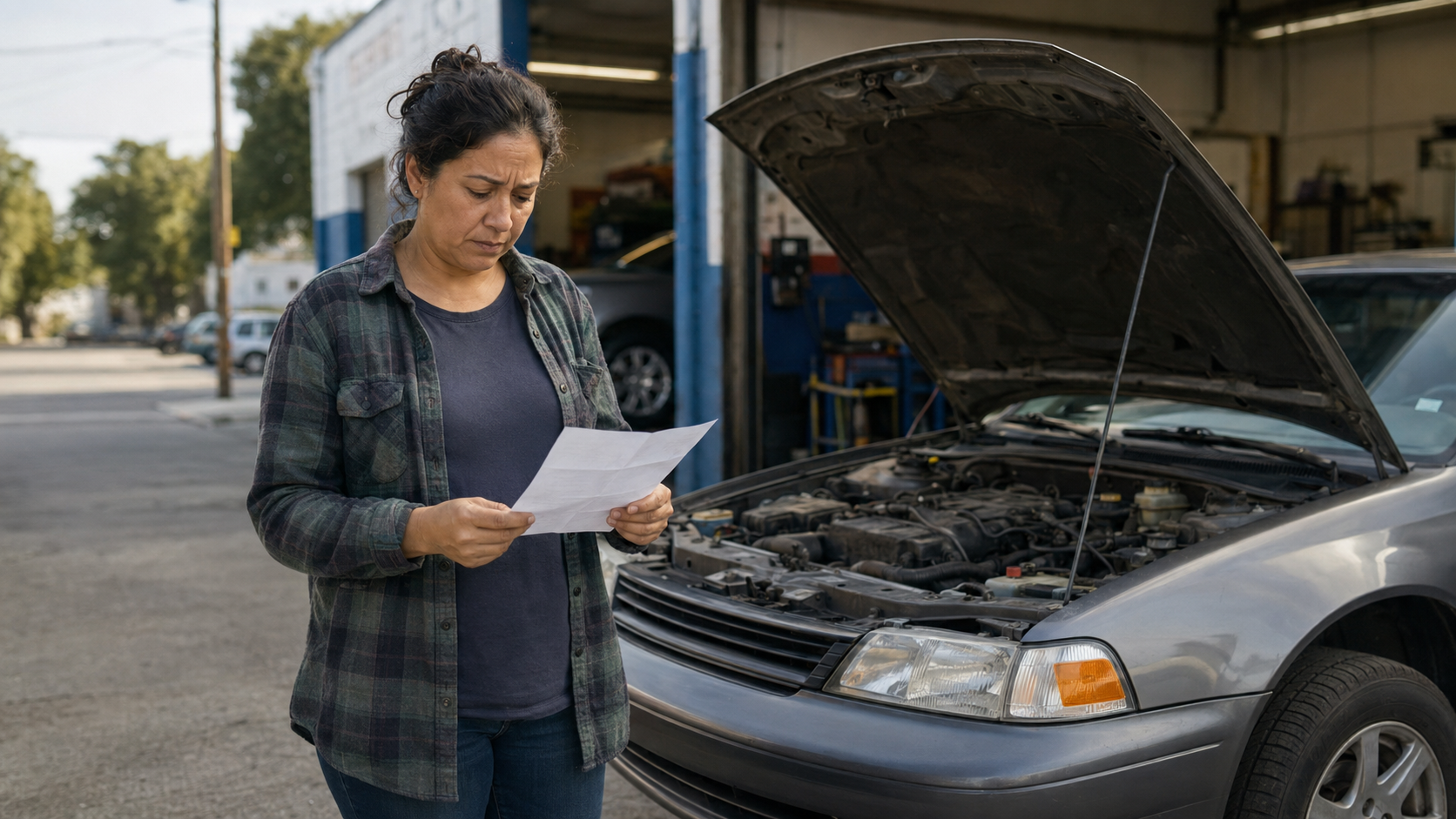
Your car just died, or it's making a sound that no car should make, and the shop wants $2,000 you don't have. Maybe more. Before you put the whole thing on a credit card at 25% interest, slow down. Repair bills are more negotiable than almost anyone realizes, and there's a specific order of operations that saves people real money. Work through it top to bottom.
Don't say yes to the first quote
When you're stranded, every instinct says pay whatever they ask and make the problem go away. Fight that. The single biggest lever you have in car repair is the second opinion, and you can get one without towing the car anywhere.
- Call two or three other shops, describe the diagnosis (not just the symptom), and ask for a ballpark. "The dealer says I need a new alternator and serpentine belt, what would you charge?" Most shops will give you a rough number over the phone.
- Independent shops routinely charge 30-50% less than dealerships for the same repair, often with the same parts. A $2,400 dealer quote for a timing belt job is frequently $1,500-$1,800 at a well-reviewed independent shop.
- Ask which items on the estimate are safety-critical and which are "while we're in there" add-ons. Estimates often bundle the urgent repair with deferred maintenance. You can split them.
- Get the estimate in writing and take a day. A shop can charge a diagnostic fee (usually $75-$150), but they can't hold your car hostage over a repair you haven't authorized.
For context on typical prices: a battery replacement runs $150-$300, brake pads and rotors $300-$800 per axle, an alternator $400-$800, a starter $350-$700, a serpentine belt $80-$200, a radiator $500-$1,000, and a transmission rebuild $2,500-$4,500. If a quote is way outside these ranges, ask why.
Check whether the repair is already covered
People pay out of pocket for covered repairs constantly, because nobody checks. Spend fifteen minutes on this before you spend a dollar.
- Open recalls. Go to NHTSA.gov, enter your VIN, and see if your problem matches an open recall. Recall repairs are free at any dealership for that brand, no matter how old the car is or how many owners it's had.
- Powertrain and extended warranties. Manufacturer powertrain warranties often run 5 years or 60,000 miles, sometimes 10/100,000 on Kia and Hyundai. If a dealer sold you an extended service contract, dig up the paperwork; you may have coverage you forgot buying.
- Technical service bulletins and "goodwill" repairs. If your car has a known defect that's common for the model, call the manufacturer's customer line and ask about goodwill assistance. It's discretionary, but automakers do cover out-of-warranty repairs for well-documented problems, especially for loyal owners with service records.
- Your auto insurance. Mechanical breakdown coverage is rare, but towing and roadside assistance riders are common and forgotten. That's $100-$200 you don't need to eat.
Negotiate the bill itself
Mechanics negotiate all day. You won't offend anyone. A few asks that actually move the number:
- "What does this look like with aftermarket parts instead of OEM?" For most repairs, quality aftermarket parts cost 30-50% less and perform fine. For safety systems and anything under warranty, stick with OEM.
- "Is there a cash discount?" Card processing costs shops 2-3%, and many will knock 5-10% off for cash.
- "Can I supply my own parts?" Sites like RockAuto often sell the same part for half what a shop marks it up to. Some shops refuse or won't warranty customer-supplied parts, but it never hurts to ask on a big-ticket item.
- "What's the minimum to make it safe to drive?" Fix the brakes now, schedule the rest for next month's paycheck.
- "Do you offer a payment plan?" Many shops partner with financing programs, and some family-run shops will split a bill over two or three payments for a regular customer.
Decide whether the car is worth fixing at all
There's a point where you're throwing money at a car that's done. A rough rule: if the repair costs more than half the car's current market value, or if this is the third major repair in a year, price out alternatives before authorizing the work. Check the car's value on KBB.com or Edmunds; a $3,000 transmission in a car worth $3,500 rarely makes sense unless the rest of the car is genuinely solid.
That said, don't jump from a $2,000 repair to a $500-a-month car payment out of frustration. A repaired car you own outright is almost always cheaper than replacing it. Run the math both ways.
If you still can't cover it, in this order
Say you've negotiated, checked coverage, and the number is still out of reach. Here's the rough order of least-bad options:
- Shop payment plan or 0% promotional financing. If you're confident you can pay it off during the promo window, this is essentially an interest-free loan. If you're not confident, deferred-interest cards can hit you with all the back interest at once, so read the terms.
- Credit union Payday Alternative Loan (PAL). Federal credit unions offer small loans of $200-$2,000 with capped rates far below payday lenders. You typically need to be a member for a month, and joining is often $5-$25.
- A personal loan from your bank or credit union. Rates vary a lot with credit score, but even a mediocre-rate personal loan beats carrying the balance on a credit card.
- Local assistance. Dial 211 or search 211.org for local emergency assistance programs; some community organizations, churches, and workforce agencies help with car repairs specifically when the car is needed to get to work. Programs like Ways to Work exist in some regions for exactly this.
- Your employer. Some employers offer emergency hardship loans or advances, and Employee Assistance Programs sometimes include financial help. Awkward to ask, cheaper than a payday loan.
The option to avoid: title loans. They're marketed to exactly this situation, and they routinely end with people losing the car they were trying to save. Payday loans aren't much better; a $500 payday loan can cost $75 in fees every two weeks it rolls over.
Getting by while the car's in the shop
A repair that takes a week creates its own costs. A few things that soften it: ask the shop about a loaner (independents sometimes have one for big jobs), check whether your insurance has rental reimbursement, ask a coworker for a temporary carpool, and see if your job allows a few remote days. If you're in a city, a week of buses and the occasional rideshare usually costs far less than a rental.
And once you're through this: put the repair behind you, then start putting even $50 a month into a separate account labeled "car." Cars are machines. Something else will break eventually, and future-you would rather be annoyed than panicked.
Sources and further reading
The claims in this article were checked against the primary sources below. Programs, limits and costs change, so the official pages are always the final word.
- Check for Recalls: Vehicle, Car Seat, Tire, EquipmentNational Highway Traffic Safety AdministrationFree VIN recall lookup; recall repairs are free at a franchised dealer regardless of the car's age or owner count.
- Payday Alternative LoansNational Credit Union AdministrationPAL loan sizes, membership requirement, and the capped rate that beats payday and title lenders.
- What is a payday loan?Consumer Financial Protection BureauHow payday fees compound on rollover, which is the basis for the warning against payday and title loans.
- Call 211 for Essential Community ServicesUnited Way 211Finding local car-repair and transportation-to-work assistance programs.