How to Save $300-$700 Per Year on Gas
Simple changes to driving habits and fuel-buying strategy that add up to real savings. Plus the best gas rewards programs.
Dave Brennan
Risk & Investor Behavior
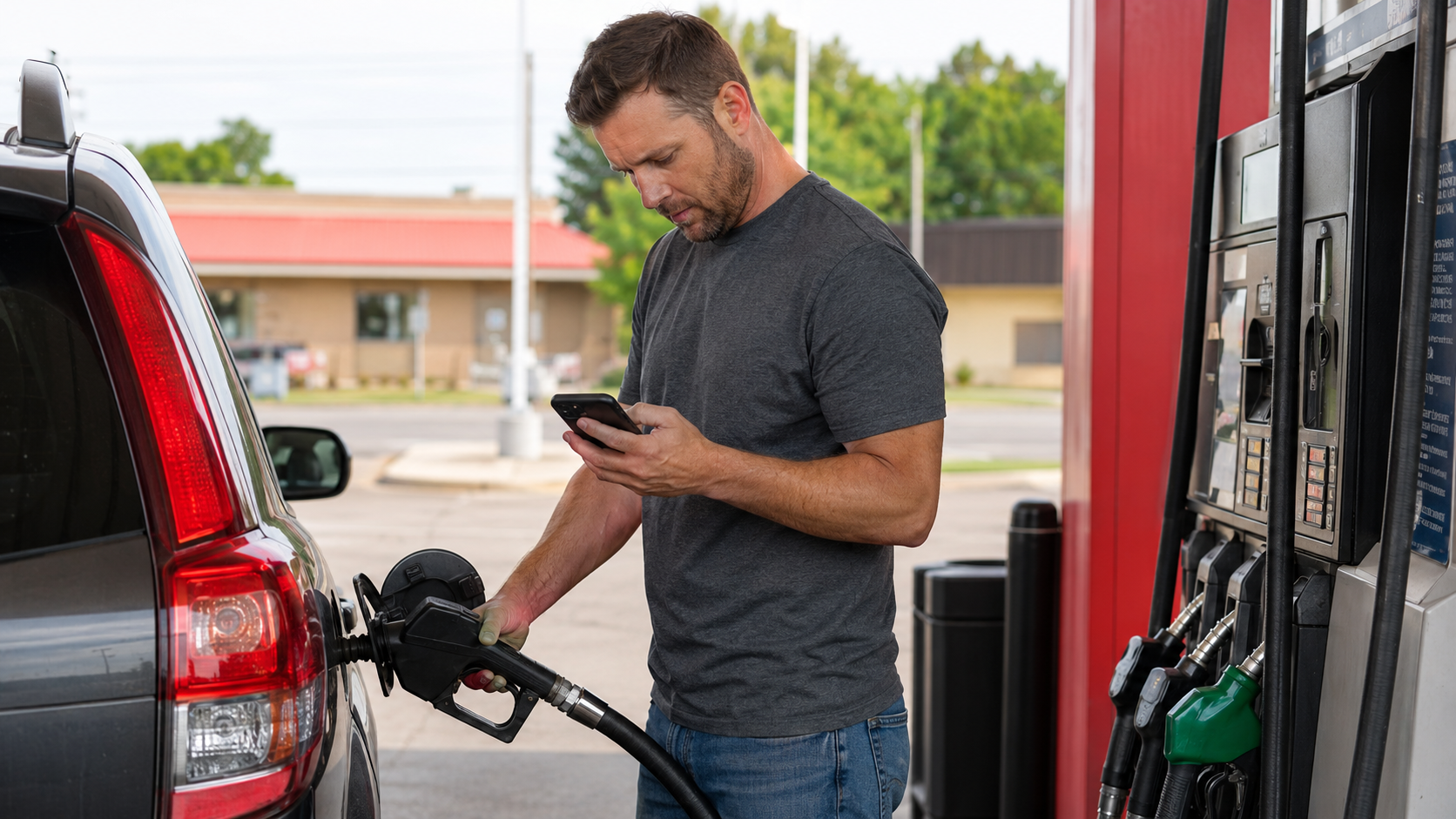
A typical driver covering 12,000-15,000 miles a year spends $1,500-$2,500 on gas. The gap between paying attention and not paying attention, where you buy, how you drive, whether your tires are inflated, is worth $300-$700 a year. None of it requires a new car or a lifestyle change.
Stop Overpaying at the Pump
Gas prices vary $0.30-$0.50 a gallon between stations in the same few miles, and the station you habitually use is probably not the cheap one. This is the fastest win:
- Use GasBuddy or the fuel-price layer in Google Maps or Waze before you're on empty. Choosing the cheap station on a route you already drive costs nothing; at 12 gallons twice a month, $0.35 a gallon is about $100 a year.
- Warehouse clubs (Costco, Sam's Club) run $0.20-$0.40 below nearby stations consistently. If you're already a member, this alone can justify the fee.
- Grocery fuel rewards: Kroger, Safeway, and similar chains give $0.10 to $1.00 off per gallon based on grocery spending you were doing anyway. Stacked with a sale, filling up for well under market price is common.
- Some stations charge $0.05-$0.10 less for cash. Worth it if it's on your way, not worth a special trip.
- A card that pays 3-5% on gas (several no-annual-fee cards do) returns $50-$120 a year at typical spending. Only relevant if you pay the balance in full; interest eats gas rewards for breakfast.
One thing not to do: drive across town to save six cents. Burning half a gallon to save sixty cents is how people lose money feeling thrifty.
The Driving Habits That Actually Matter
Per Department of Energy figures, aggressive driving, hard acceleration and hard braking, can lower highway fuel economy by 15-30% and stop-and-go economy 10-40%. Speed matters too: fuel economy drops steeply above about 50 mph, and every 5 mph over that costs the equivalent of paying roughly $0.20-$0.30 more per gallon.
- Accelerate like there's a full coffee on the dashboard. Smooth beats fast, and it saves more fuel than any gadget you can buy.
- Look far ahead and coast toward red lights instead of charging at them and braking. Every hard brake throws away momentum you paid for.
- Set cruise control on the highway and try 65-70 instead of 75-80 on trips. On a 300-mile drive the slower speed costs you about 15-20 minutes and saves a couple gallons.
- Don't idle. If you're parked and waiting more than a minute or so, shut the engine off. Idling gets zero miles per gallon, and modern engines don't need to "warm up" beyond about 30 seconds even in winter.
- Combine errands into one loop. A cold engine runs rich; five short cold-start trips burn noticeably more than one warm circuit.
Five-Minute Maintenance That Pays for Itself
- Tire pressure, monthly. Underinflated tires cost 1-3% in fuel economy and wear out early. Use the pressure on the driver's door jamb sticker, not the number molded into the tire.
- Skip premium unless your car requires it. If the manual says regular, premium buys you nothing but a 20-30% higher price per gallon. "Premium recommended" engines run fine on regular with a negligible difference for normal driving.
- Take the roof rack or cargo box off when you're not using it, at highway speed a box can cut fuel economy 10-25%. Empty the trunk of the stuff living there, too; extra weight costs, especially in city driving.
- Keep up with basic maintenance. A seriously neglected engine, a stuck brake caliper, or a bad oxygen sensor can quietly tax every tank; a check-engine light is sometimes a fuel-economy problem announcing itself.
The Structural Wins
The habits above are worth hundreds. The next tier is worth thousands, and it's about how many miles you buy gas for at all. If your employer allows even one or two remote days a week, that's 20-40% of commute fuel gone. Carpooling with one coworker halves the commute cost for both of you. And when you eventually replace your car, the mpg difference matters more than almost any other line on the sticker: at 13,000 miles a year, moving from a 22 mpg vehicle to a 35 mpg one saves roughly $700-$900 a year at typical gas prices, every year you own it. Run any candidate car through FuelEconomy.gov's cost calculator before you fall in love with it.
Myths That Cost You Money
- Fuel additives, magnets, and "chip tuners" promising 20% mpg gains: independent testing has never backed them up. Save the $20.
- Filling up in the morning "when gas is denser": station tanks are buried and stay at nearly constant temperature. The difference is a rounding error.
- Letting the tank run to empty to "lighten the car": the weight savings is trivial, and repeatedly running low can shorten the life of the fuel pump on many cars, a $400-$900 repair to save pennies.
- Air conditioning versus open windows: at city speeds, windows down is cheaper; at highway speed the drag from open windows roughly cancels the AC savings. Use whichever keeps you comfortable and don't overthink it.
The boring stuff, cheap stations, smooth driving, inflated tires, fewer cold starts, and buying an efficient car when replacement time comes, is the whole game. Pick the three easiest items from this list and they'll quietly return a few hundred dollars a year for as long as you drive.
Sources and further reading
The claims in this article were checked against the primary sources below. Programs, limits and costs change, so the official pages are always the final word.
- Gas Mileage Tips: Driving More EfficientlyU.S. Department of Energy and U.S. Environmental Protection AgencyThe aggressive-driving penalty, the drop in economy above about 50 mph, idling, and cargo-carrier drag.
- Gas Mileage Tips: Keeping Your Vehicle in ShapeU.S. Department of Energy and U.S. Environmental Protection AgencyTire inflation and maintenance effects on fuel economy, including the door-jamb pressure figure.
- Selecting the Right Octane FuelU.S. Department of Energy and U.S. Environmental Protection AgencyWhy premium buys nothing in an engine that only requires regular.
- Gas Prices: Frequently Asked QuestionsU.S. Department of Energy and U.S. Environmental Protection AgencyUsed to check the fuel-saving myths, including morning fill-ups and aftermarket mileage devices.
- Gasoline and Diesel Fuel UpdateU.S. Energy Information AdministrationCurrent national and regional average gasoline prices, for checking the per-gallon assumptions.