Furnace Died in the Middle of Winter? Here's What to Do Right Now
Your house is freezing and your furnace just quit. Here's how to stay warm tonight, troubleshoot before calling a tech, and avoid getting ripped off on repairs.
Priya Shah
Housing, Mortgages & Insurance
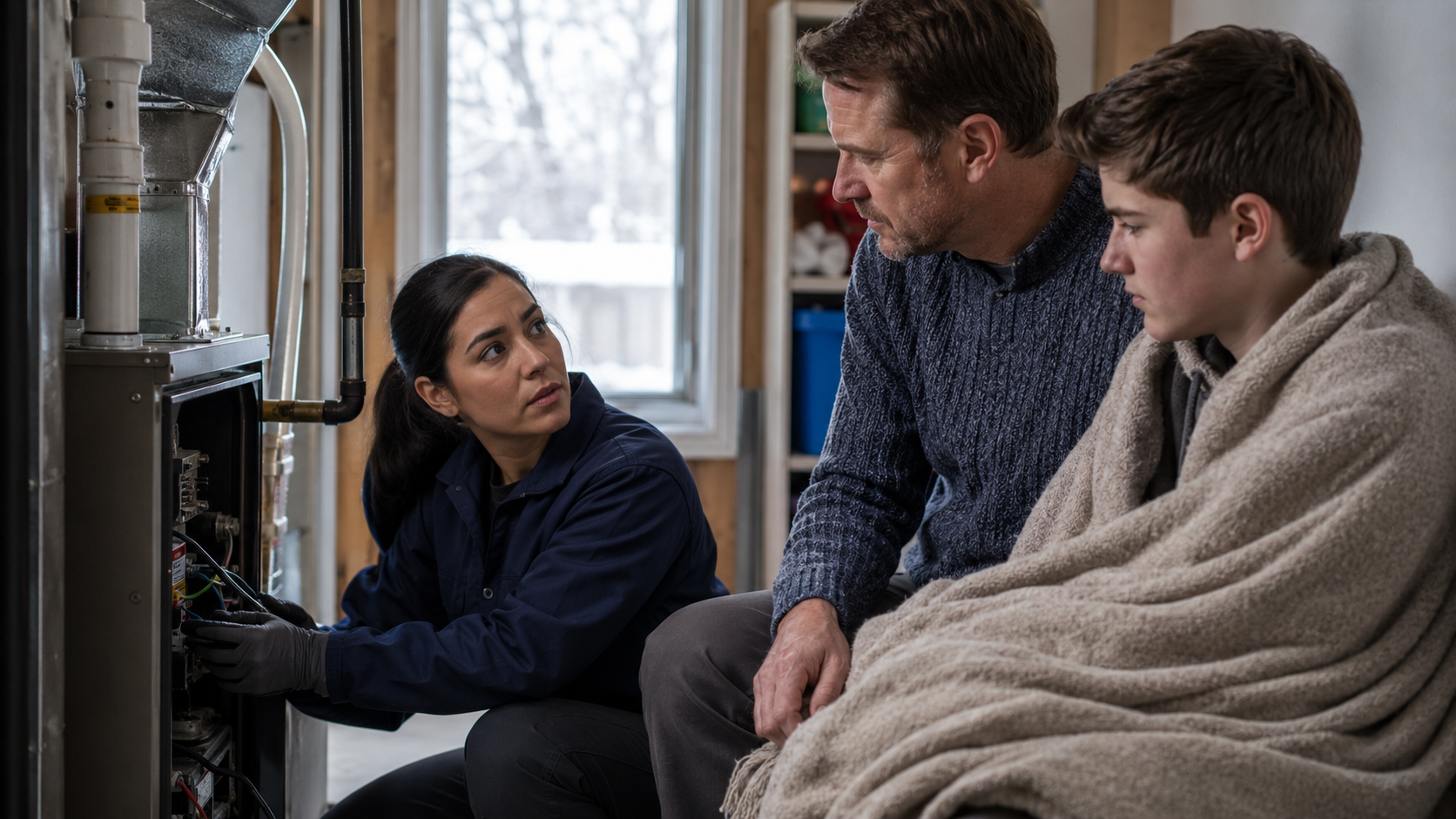
Your furnace quit, it's below freezing outside, and the temperature inside is dropping by the hour. This is one of the few home emergencies with a real clock on it — so this guide is ordered by urgency: keep everyone safe tonight, try the ten-minute fixes that resolve a surprising share of "dead" furnaces, then handle the repair call without getting gouged.
Keep the house safe tonight
Indoor temperatures below about 60°F start becoming genuinely risky for babies, elderly family members, and anyone with health conditions. Handle tonight first:
- Consolidate into one small room and close it off. Hang blankets over doorways if you have to — it looks absurd and works remarkably well. Body heat in a small space counts.
- Space heaters are fine used correctly: plugged directly into the wall (never a power strip), three feet from anything flammable, off while you sleep unless it has tip-over and overheat shutoffs.
- Never heat with the oven, a grill, or any outdoor propane device. Carbon monoxide from improvised heating kills hundreds of Americans every winter, most of them during exactly this situation.
- Let faucets drip and open cabinet doors under sinks on exterior walls. A frozen, burst pipe turns a $400 furnace problem into a $10,000 water problem.
- If the indoor temperature is heading below 50°F with vulnerable people in the house, call 211. They connect you with warming centers and, in many areas, emergency hotel vouchers and heating assistance.
The ten-minute checks before you call anyone
HVAC techs will tell you a meaningful share of winter emergency calls end with the tech flipping a switch and collecting $150. Run this list first:
- Thermostat: set to HEAT, temperature above the room's current reading, and fresh batteries. Dead thermostat batteries are a genuine classic.
- Circuit breaker: find the furnace breaker in your electrical panel. If it's tripped, flip it fully off, wait 30 seconds, flip it on. (If it trips again, stop — that's a real electrical issue for a pro.)
- Furnace power switch: there's a switch that looks exactly like a light switch on or near the unit. They get bumped off in basements and closets all the time.
- Air filter: pull it out and hold it to the light. If you can't see light through it, the furnace may be overheating and shutting itself down as a safety measure. A new filter is $5–$15 at any hardware store; swap it and restart.
- Gas supply: the valve handle on the gas line should be parallel to the pipe. If other gas appliances (stove, water heater) are also out, the problem may be your gas service, not the furnace — call the utility.
- Condensate and vents: high-efficiency furnaces shut down if the drain line is clogged or the outside intake/exhaust pipes are blocked by snow or ice. Check the sidewall vents outside and clear them.
- Reset: turn the furnace off at the power switch for 60 seconds, then back on. Modern furnaces lock out after failed ignition attempts, and a reset clears the lockout.
If you smell gas at any point — rotten eggs — stop everything, leave the house, and call the gas utility's emergency line from outside. That is not a troubleshooting situation.
Calling a tech without getting winter-emergency pricing
- Call two or three companies even now. Diagnostic fees run $75–$150 and are often waived or credited if you proceed with the repair — ask on the phone.
- After-hours and weekend calls typically bill at 1.5–2x normal rates. If the house is safely holding above 55°F with space heaters, waiting for the 8 a.m. slot can save $150–$300 on the same repair.
- Get the diagnosis and price in writing before authorizing work, and ask them to show you the failed part. Honest techs do this without being asked.
- Typical repair costs for calibration: ignitor $150–$400, flame sensor cleaning $80–$200, blower motor $400–$1,500, control board $400–$700, draft inducer motor $300–$900. A quote wildly above these ranges deserves a second opinion.
- Be politely skeptical of a same-visit hard sell on a full replacement, especially with a "today only" discount attached. A dying furnace that limps through a week gives you time to bid the job properly; a genuinely dangerous one (cracked heat exchanger with confirmed CO) is the exception, and you can still ask for the CO readings.
Repair or replace: the actual framework
Furnaces last roughly 15–20 years. The decision rule most honest techs use: multiply the repair cost by the furnace's age; if the result is over about 5,000, replacement starts making sense. In plainer terms:
- Under 10 years old: repair it, almost regardless of the quote. You have a decade of life left.
- 10–15 years: repair if the fix is under roughly a third to half the cost of a new unit; think harder if it's a major component like a heat exchanger.
- 15+ years with a $1,000+ repair: get replacement quotes. You're likely funding a series of repairs on borrowed time, and new units are 15–30% more efficient, which shows up on every gas bill.
- A new furnace installed runs about $3,500–$8,000 depending on size, efficiency, and region. Get three bids — spreads of $2,000+ between quotes for the same equipment are completely normal in this industry.
- If you do replace, ask about utility rebates and federal energy-efficiency tax credits for high-efficiency equipment and heat pumps; combined they can take four figures off the real cost. Your utility's website lists current programs.
If the money simply isn't there
A furnace failure is exactly the emergency several major assistance programs exist for, and they are chronically under-applied-to:
- LIHEAP, the federal energy assistance program, doesn't just help with bills — it has crisis funds that can pay for emergency furnace repair or replacement. Income limits are higher than people assume (a family of four can qualify around $60,000 in some states). Find your state office through the LIHEAP clearinghouse or by calling 211.
- The Weatherization Assistance Program covers furnace repair and replacement plus insulation for qualifying households, free. Waitlists exist, but crisis situations often move faster.
- Your gas and electric utilities have hardship programs, payment plans, and sometimes their own repair funds. The number is on your bill; ask specifically what they offer for no-heat emergencies.
- Salvation Army, Catholic Charities, and local community action agencies keep emergency heating funds precisely for this. 211 knows which ones near you have money left this season.
- Many HVAC companies offer financing; read the terms, because 0%-for-12-months from a reputable lender is fine while some contractor financing runs to card-level interest rates. A credit union personal loan is often the cheaper borrowing route.
Once heat is restored and life resumes: put a furnace tune-up on the calendar every fall. The $100–$180 annual service catches ignitors, sensors, and heat exchanger problems in October instead of at 11 p.m. in January — which, as you now know better than anyone, is the expensive time to find out.
Sources and further reading
The claims in this article were checked against the primary sources below. Programs, limits and costs change, so the official pages are always the final word.
- Carbon Monoxide Poisoning BasicsCenters for Disease Control and PreventionWhy heating with an oven, grill, or other unvented device is the dangerous part of a no-heat night.
- Low Income Home Energy Assistance Program (LIHEAP)Office of Community Services, HHSLIHEAP crisis assistance, which in many states pays for emergency heating repair and replacement.
- Weatherization Assistance ProgramU.S. Department of EnergyFree heating-system repair and insulation for income-qualified households.
- How to Apply for Weatherization AssistanceU.S. Department of EnergyHow to find and apply through your state's weatherization agency.
- Federal Tax Credits for Energy EfficiencyENERGY STAR, U.S. Environmental Protection AgencyCurrent federal credits for high-efficiency furnaces and heat pumps.